This is where consistency needs to be rebuilt differently.
You do not need a harsher routine.
You need a simpler standard you can maintain when life becomes demanding.
Many responsible adults are capable, dependable and strong for everyone else. They show up for work, family, responsibilities and other people’s problems. However, when it comes to their own goals, habits and standards, they often feel stretched, inconsistent or disconnected from the person they want to be.
That does not mean you are lazy.
More often, it means your system is too heavy for the life you are actually living.
Not through pressure. Not through guilt. Instead, through small standards you can keep even when life gets busy.
Why Consistency Feels Hard When Life Is Full
When your life is already full, consistency becomes harder because your energy is being spent in many directions.
You may be managing work pressure, family responsibilities, health, relationships, finances, decisions and daily admin. Therefore, when you finally get time for yourself, your focus is often low and your willpower is already drained.
This is why big routines often collapse.
For example, you might tell yourself:
- “I’ll train five times a week.”
- “I’ll completely change my diet.”
- “I’ll wake up at 5am every day.”
- “I’ll work on my goals every evening.”
- “I’ll stop overthinking and just get on with it.”
At first, the plan feels motivating. However, once life becomes demanding again, the routine becomes too difficult to maintain.
As a result, you feel like you have failed.
In reality, the plan failed to respect your actual life.
The Problem With Harsher Routines
When people lose consistency, they often respond by making the next plan even stricter.
They add more rules, more habits, more pressure and more expectations.
However, this usually creates another cycle:
- You feel frustrated.
- You create a strict plan.
- You follow it for a few days.
- Life gets busy.
- You miss a day.
- You feel like you have failed.
- You stop completely.
The issue is not always discipline.
Sometimes, the issue is that the standard is too complicated to survive pressure.
A Spartan approach is different.
It removes what is unnecessary and focuses on what can be repeated.
The Simpler Standard Principle
The Simpler Standard Principle is this:
Choose a standard small enough to maintain, but meaningful enough to matter.
That means your goal is not to create the most impressive routine.
Your goal is to create a reliable one.
For example:
Instead of “I must train five times this week,” try:
“I will move for ten minutes every day.”
Instead of “I must sort my whole life out this month,” try:
“I will complete one focused block three times this week.”
Instead of “I need to fix everything,” try:
“I will choose one promise to keep today.”
When the standard becomes simpler, it becomes easier to repeat. As a result, you begin collecting evidence that you can rely on yourself again.
That evidence is what rebuilds consistency.
Step 1: Choose One Area to Rebuild First
Do not try to rebuild every area of your life at once.
That is how overwhelm returns.
Instead, choose one area for the next seven days:
- Mindset
- Health
- Relationships
- Career
- Personal organisation
- Sleep
- Fitness
- Confidence
- Communication
Ask yourself:
“Which area, if improved slightly, would make the rest of life easier?”
For many people, the answer is energy, sleep or weekly structure. For others, it may be communication, confidence or focus.
Once you choose the area, keep it simple.
One area. One standard. One week.
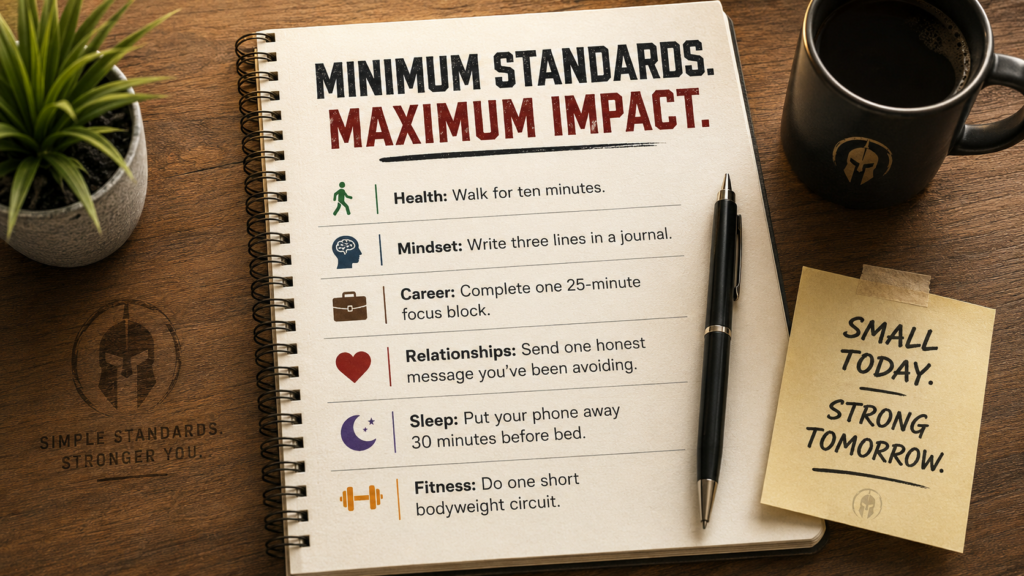
Step 2: Create a Minimum Standard
A minimum standard is the smallest version of the habit that still counts.
It matters because busy weeks need a fallback plan.
Examples of minimum standards
Health:
Walk for ten minutes.
Mindset:
Write three lines in a journal.
Career:
Complete one 25-minute focus block.
Relationships:
Send one honest message you have been avoiding.
Sleep:
Put your phone away 30 minutes before bed.
Fitness:
Do one short bodyweight circuit.
The standard should feel almost too easy.
That is the point.
When the action is small, resistance drops. Meanwhile, your identity begins to shift because you are becoming someone who follows through.
Step 3: Use Spear & Shield to Start
Overthinking often appears just before action.
That is why you need a quick starting method.
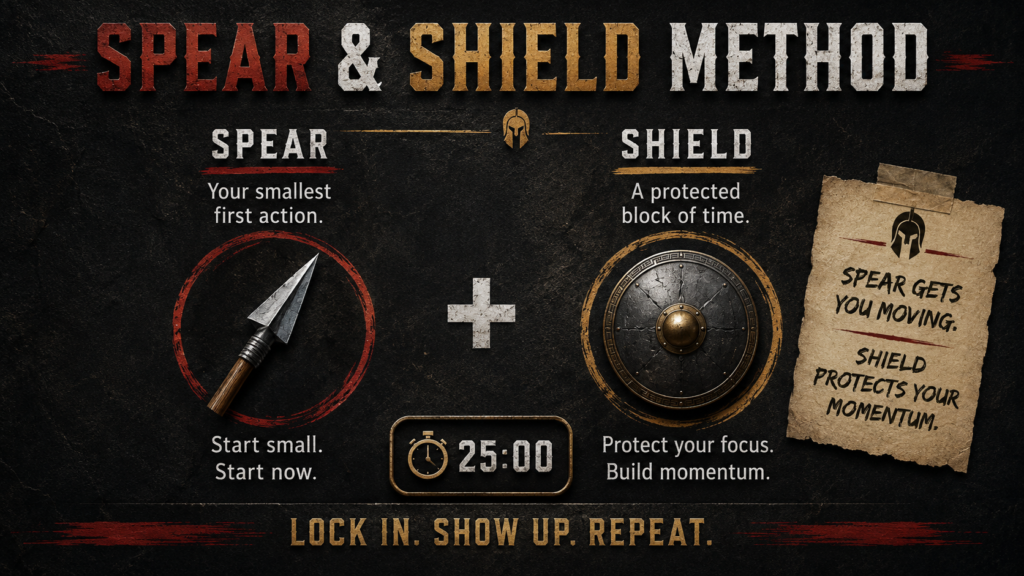
The Spear & Shield Method is simple:
- Spear: your smallest first action
- Shield: a protected block of time
For example, if your goal is to work on a project, your Spear might be opening the document and writing the first heading.
Your Shield might then be a 25-minute timer with your phone out of reach.
If your goal is health, your Spear might be putting your trainers on. Your Shield might be a ten-minute walk.
The Spear gets you moving. The Shield protects your momentum.
Together, they help you start before overthinking takes control.
Step 4: Build a Spartan Week
Consistency improves when your week has structure.
Not a packed schedule. Not every minute controlled. Just enough structure to stop your priorities being pushed out by noise.
A simple Spartan Week includes:
- One main focus
- Three protected action blocks
- One daily minimum standard
- One weekly review
Example
Main focus: rebuild energy
Minimum standard: 10-minute walk daily
Protected blocks: Monday, Wednesday and Friday
Weekly review: Friday afternoon or Sunday evening
This gives your week a clear rhythm.
In addition, it removes the need to keep deciding what matters. You already know.
Step 5: Use Weekly Self-Check-Ins
A weekly self-check-in is not a judgement session.
It is a reset point.
At the end of each week, ask:
- What worked?
- What got in the way?
- What needs to be simpler?
- What should I keep next week?
- What should I remove?
This matters because consistency is not built by ignoring reality.
It is built by adjusting to it.
If something did not work, do not attack yourself. Instead, reduce the friction.
For example:
- If 30 minutes was too much, try 10.
- If evenings failed, try mornings.
- If you forgot, attach the habit to something you already do.
- If the task felt too vague, make it more specific.
The goal is not perfection.
The goal is to keep returning.
Step 6: Never Miss Twice
Life will interrupt you.
You will miss a day. Forget something. Have a poor night’s sleep. You will get busy. You will lose focus.
That is normal.
The rule is:
Never miss twice.
One missed action is life.
Two missed actions can become a pattern.
Therefore, if you miss the walk today, walk tomorrow. If you skip the focus block, protect the next one. If your sleep routine slips, return to it the following evening.
This removes the drama from inconsistency.
Instead of starting again from scratch, you simply return to the next small action.
The 7-Day Consistency Reset
Use this simple reset to begin.
Day 1: Choose one area
Pick one area to focus on for the next week.
Write:
“This week, I am rebuilding consistency in __________.”
Day 2: Set your minimum standard
Choose one small action.
Write:
“My minimum standard is __________.”
Day 3: Add your Spear
Decide the smallest first action.
Write:
“My Spear is __________.”
Day 4: Add your Shield
Protect time for the action.
Write:
“My Shield is __________ minutes at __________.”
Day 5: Track the evidence
Use a tick, note or checklist.
Do not track perfection. Track completion.
Day 6: Return if you miss
If you miss a day, return immediately.
Remember: never miss twice.
Day 7: Review
Ask:
- What helped?
- What made it harder?
- What should stay?
- What should become simpler?
Then repeat for another week.
Common Problems and Simple Fixes
“I do well for a few days, then stop.”
Your standard may be too big.
Reduce it until it becomes easier to complete on a difficult day.
“I do not have time.”
Choose a 5 to 10-minute action.
If you cannot maintain that, the action is still too large or badly placed in your day.
“I keep forgetting.”
Attach the habit to something you already do.
For example:
- After brushing your teeth
- After making coffee
- After finishing work
- Before opening social media
- Before getting into bed
“I lose motivation.”
Do not wait for motivation.
Use the Spear and begin with the smallest first action.
Motivation often follows movement.
“I feel like I have failed too many times.”
Start with evidence, not emotion.
Keep one small promise today.
That is enough to begin rebuilding trust.
How This Fits the 90-Day Spartan Reset
The 90-Day Spartan Reset is built around the same idea:
You do not need to change everything overnight.
You need a simple structure that helps you keep moving.
Inside the Reset, you work across mindset, health, relationships and career using practical tools such as:
- Spear & Shield
- The Spartan Week
- Strong Body, Calm Mind
- A.L.A Method
- Self-trust promises
- Weekly self-check-in prompts
The aim is not to become perfect in 90 days.
The aim is to become more consistent, more aware and more capable of returning when life gets demanding.
Final Thought
If life already feels full, the answer is not always to push harder.
Sometimes, the strongest move is to simplify.
Choose one standard.
Make it small.
Protect it.
Track the evidence.
Then repeat.
That is how consistency returns.
Not through pressure, but through proof.
Your Next Step
Choose one small standard to keep for the next seven days.
If you want help getting started, download the free Spartan Guide or book a free discovery call.
If you are ready for a structured self-led programme, the 90-Day Spartan Reset is available for a one-time founder price of £47.
Download the Free Guide
Book a Free Discovery Call
Start the 90-Day Spartan Reset
Frequently Asked Questions
How do I rebuild consistency when I am already busy?
Start with one small standard that fits your real life. Keep it simple enough to complete even on a demanding day.
What is the best habit to start with?
Choose the habit that would make the rest of life easier. For many people, that is sleep, movement, planning or one focused work block.
What if I miss a day?
Return the next day. One missed action does not ruin progress. The key rule is: never miss twice.
Do I need a strict routine?
No. A strict routine may work for some people, but most busy adults need a simpler standard they can maintain under pressure.
Is the 90-Day Spartan Reset personalised coaching?
No. The 90-Day Spartan Reset is a self-led digital programme. Personal coaching may be discussed separately through a free discovery call.
