You do not rebuild confidence by simply telling yourself to feel more confident.
Instead, you rebuild it by collecting evidence that you can rely on yourself.
Every time you follow through on a small promise, you strengthen that evidence. On the other hand, when you repeatedly say, “I’ll start tomorrow,” but take no action, your confidence slowly begins to weaken.
The good news is that self-trust can be rebuilt.
Not through perfection. Not through huge promises. Rather, it grows through small actions repeated consistently.
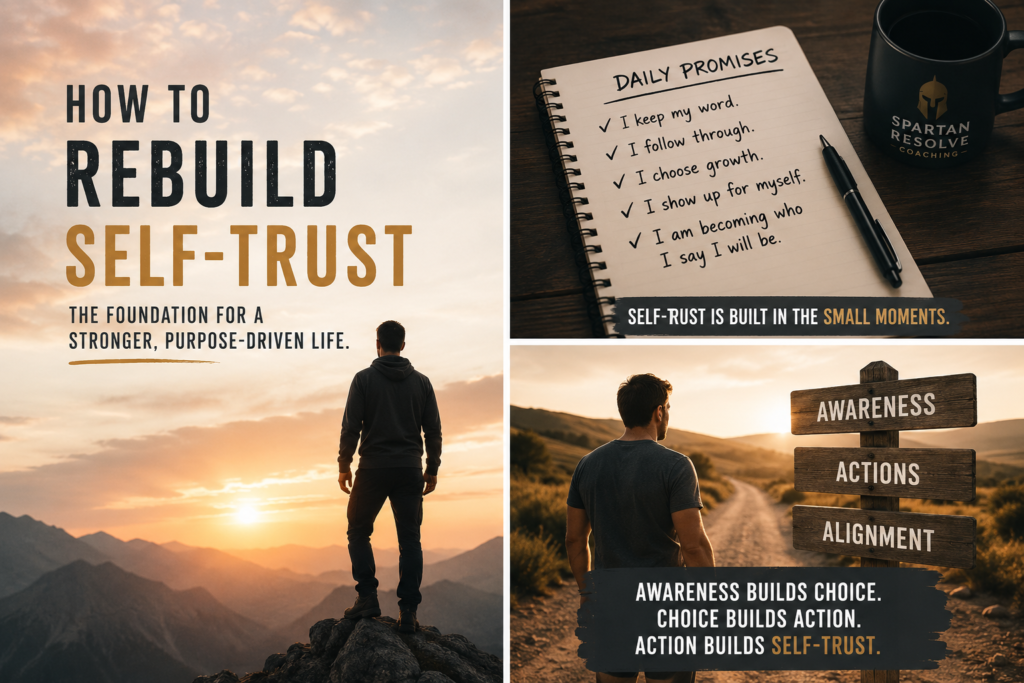
Why Self-Trust Matters
Self-trust is the belief that you will do what you say you are going to do.
It affects almost every area of life:
- Your confidence
- Your discipline
- Your health
- Your relationships
- Your career
- Your ability to handle pressure
When self-trust is strong, you make decisions more clearly. In addition, you recover from setbacks faster because you know you can rely on yourself.
However, when self-trust is low, even simple goals can feel overwhelming.
You may begin to question your ability, delay important decisions or avoid starting altogether.
How Self-Trust Gets Damaged
Self-trust rarely disappears overnight.
More often, it is worn down gradually.
For example:
- You promise yourself you will train, but skip the session.
- You decide to deal with an important task, but avoid it.
- You set a boundary, then immediately abandon it.
- You create an ambitious plan, but stop after three days.
One missed action is not the problem. Life happens.
The real damage comes when missed actions become a repeated pattern.
Eventually, you stop believing your own plans.

The Spartan Promise Principle
A Spartan approach to self-trust is simple:
Make the promise small enough to keep, but meaningful enough to matter.
Many people make the mistake of choosing goals that sound impressive but are difficult to sustain.
For instance:
- “I will train every day.”
- “I will wake up at 5am.”
- “I will completely change my diet.”
- “I will work on my business for three hours every evening.”
Although these promises sound powerful, they often collapse under real-life pressure.
A better approach is to create a smaller commitment.
For example:
- Train twice this week.
- Walk for ten minutes today.
- Prepare one healthy meal.
- Work on the business for twenty-five focused minutes.
As a result, the promise becomes easier to honour.
Choose One Daily Non-Negotiable
To rebuild self-trust, start with one action.
Not five. Not ten. One.
Your non-negotiable should be:
- Simple
- Clear
- Measurable
- Realistic
- Connected to something that matters
Examples might include:
- Walk for ten minutes
- Read five pages
- Drink one bottle of water before lunch
- Complete one focused work block
- Write three lines in a journal
- Prepare tomorrow’s first meal
- Send one important message
- Put your phone away thirty minutes before bed
The goal is not to impress anyone.
The goal is to prove to yourself that you follow through.
Track Evidence, Not Feelings
Motivation changes from day to day.
Evidence does not.
Therefore, rather than asking, “Do I feel confident?” ask:
“What proof do I have that I kept my promise today?”
A simple tracker is enough.
You could use:
- A tick on a calendar
- A note in your phone
- A habit-tracking app
- A written checklist
- A weekly journal
Each completed action becomes another piece of evidence.
Over time, the pattern begins to change.
You stop seeing yourself as someone who is always starting again. Instead, you begin to see yourself as someone who follows through.
Use the Never Miss Twice Rule
Missing one day does not destroy progress.
However, missing twice can begin a new pattern.
That is why the rule is simple:
Never miss twice.
If you miss your walk today, walk tomorrow.
You skip your focus block, protect the next one.
If you break your sleep routine, return to it the following evening.
This removes the drama from setbacks.
Instead of saying, “I’ve ruined it,” you simply return to the next action.
Progress does not require perfection. It requires recovery.

Start Smaller Than Your Ego Wants
Sometimes the action feels too small.
That is usually a good sign.
Your ego may want the dramatic plan. Yet your confidence needs consistency.
For example, ten minutes of focused work may feel insignificant. Nevertheless, ten minutes completed is more valuable than a two-hour plan repeatedly postponed.
Small actions create momentum.
Momentum creates evidence.
Evidence creates self-trust.
The Seven-Day Self-Trust Challenge
Choose one small promise and complete it for seven days.
Step 1: Choose the promise
Write:
For the next seven days, I will ____________________.
Keep it realistic.
Step 2: Set a clear trigger
Decide when the action will happen.
For example:
- After breakfast, I will walk for ten minutes.
- At 7pm, I will complete one focus block.
- Before bed, I will prepare tomorrow’s clothes.
- After lunch, I will drink a full bottle of water.
A clear trigger reduces decision-making.
Step 3: Track completion
Mark each day with a simple tick.
Do not rate the quality. Just record whether it happened.
Step 4: Recover quickly
If you miss a day, complete the action the next day.
Remember: never miss twice.
Step 5: Review at the end
After seven days, ask:
- What helped me follow through?
- What got in the way?
- Did the promise feel realistic?
- What evidence did I collect?
- What should I continue next week?
Common Problems and Simple Fixes
“I keep making the goal too big.”
Reduce the action until it feels almost impossible to avoid.
Ten minutes becomes five.
Five pages becomes one.
One hour becomes twenty-five minutes.
“I forget.”
Attach the action to something you already do.
For example:
- After brushing your teeth
- After your first coffee
- Before opening social media
- Immediately after work
- Before getting into bed
“I miss one day and lose momentum.”
Return to the rule: never miss twice.
One missed day is an event. Two missed days can become a pattern.
“I do not feel motivated.”
Complete the smallest version of the action.
Motivation often follows action rather than coming before it.
“I no longer believe I can change.”
Do not ask yourself to believe everything will change.
Instead, ask yourself to keep one small promise today.
That is enough.
How This Fits the 90-Day Spartan Reset
Self-trust sits underneath the entire 90-Day Spartan Reset.
You use:
- Spear & Shield to start before overthinking takes over
- The Spartan Week to organise your priorities
- Strong Body, Calm Mind to protect your energy
- A·L·A to strengthen communication
- Small promises to build the identity of someone who follows through
Together, these methods create a simple system for consistent progress.
Final Thought
Confidence is not built by waiting until you feel ready.
It is built by proving to yourself, repeatedly, that you can be trusted.
Start small.
Keep one promise.
Then keep another.
Over time, those small actions begin to change how you see yourself.
Your Next Step
Choose one promise to keep for the next seven days.
Write it down now.
Then take the first small action today.
Read the 90-Day Spartan Reset
Use the Spear & Shield Method
Plan Your Spartan Week
Book a 15-Minute Call
Frequently Asked Questions
How long does it take to rebuild self-trust?
You may notice a difference within a few days. However, stronger self-trust develops through repeated evidence over several weeks.
What should my first promise be?
Choose something small, specific and meaningful. A ten-minute walk, one focus block or a simple evening routine are good starting points.
What happens if I miss a day?
Return the following day. One missed action does not erase your progress.
Should I increase the goal after seven days?
Only increase it if the current action feels stable. Consistency matters more than difficulty.
